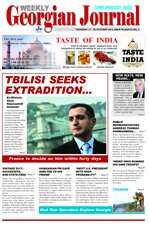
The United States intelligence concluded that should Saakashvili decide to take the position of Prime Minister, he would not face any constitutional hurdle. In other words, the constitution hastily adopted last summer, is working fine. Apparently, the year of 2015 did not sound in several quotes of the Presidential report accidentally. It must be the year by which Saakashvili postponed the deadline for the completion of national revival and ripening of the moment for the EU to beg us join the union.
Meanwhile Die Welt published a number of Wikileaks cables revealing attitudes of European leaders towards the Georgian Authorities. We talked with Kakha Katsitadze on current and future political processes.
Q: In the chapter on the Caucasus and Central Asia in his report to the Senate Intelligence Committee, James Clapper, Head of American national intelligence, pointed out that even though Saakashvili has not been disclosing his future plans, the new constitution would give him all the instruments to stay in power after the end of his term in 2013 in the role of the Prime-Minister. Did they in the United States got accustomed to internal tensions in Georgia, as if they were routine political bulging?
A: Intelligence of the United States, and any other country in principle, is inclined to always avoid political assessment and interpretation of facts and events. The report merely states that by all accounts Saakashvili is intent on becoming the Georgian Prime Minister. However, the conclusion is up to politicians. In the past I happened to read certain CIA classified data. At that time national intelligence did not even exist. So, I happened to read sections on Georgia too. The style was always the same. The paper used to note the trend without making judgments. What we could possibly deduce from it is the simple understanding that Saakashvili will try to stay in power through the position of Prime-Minister. No more than that.
Q: So, it appears he has both desire and a good chance of such political reincarnation?
A: I think the ongoing events in the Middle East prove the opposite. It’s the fact that situation worsens yearly in Georgia.
Q: The information about the closure of the Israeli Embassy was followed by somewhat ambiguous and controversial comments. While the Israeli side remains silent on the matter, Georgian Foreign Ministry ties everything with moving to a new building. Several members of the Parliamentary Majority suppose that recent relations of Georgia with its regional neighbor Iran might be connected with this odd story. Others see the connection with the recent scandalous detainment of Israeli businessmen in Georgia.
A: Let us put it this way. It is not an indicator that Georgia strengthened its position on the international arena. The fact that the Foreign Ministry says something while the Israeli Embassy maintains aura of unnatural tranquility speaks volumes about the significance of the story and that whatever the Foreign Ministry tries to explain is not what the Israeli side may be thinking in reality. In fact, the latter must be thinking differently as it is not confirming the Georgian version. Thus, the fact sends Georgia one more step backward on the international arena.
Q: On the basis of WikiLeaks material, Die Welt published an interesting article “NATO plays the role of a happy family”. The article describes processes inside NATO during the Russian-Georgian war in August 2008. In particular, it quotes the Dutch saying that Georgia is “an immature democracy”, while Saakashvili is “an emotional, corrupted Head of State who cannot be trusted”. The article also notes that Germans called Saakashvili dangerous.
A: First, let me remind you the other publication that saw the light quite soon after the August war. It was a Le Mond article by English journalist Jonathan Little. He recollected his days in Gori in the middle of the war. Among other things he talks about his dialogue about Saakashvili with Kakha Lomaia, then the Secretary of Security Council of Georgia. While travelling in a car together with him, Lomaia asked him in a low voice what they in the west thought about Saakashvili. Why was Lomaia scared? Perhaps, he was apprehending Little’s answer to his question in advance that Saakashvili was seen by some people as inadequate, while others called him insane. On hearing it all, Lomaia’s face grew pale. He asked several times whether Misha was really viewed as insane. Such views were expressed in the western press in 2008. So, we can forget about close collaboration with the European Union and NATO until this administration is in power. The Russian factor is of secondary importance in this regard. There will be movement only by inertia, nothing else.